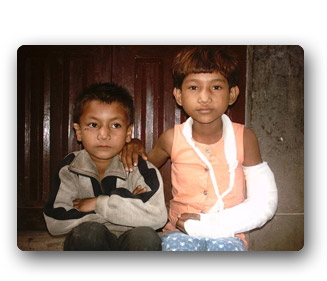
© photos APC
Kids sleeping in the street (January 2004).
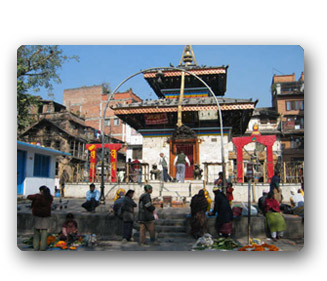
© photo APC
Mahendreshwar temple, dedicated to Shiva, Durbar Square, Kathmandu.
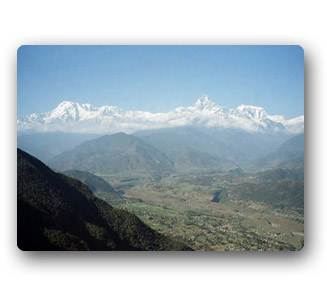
© photos APC
View from Sarangkot, famous Annapurna viewpoint near Pokhara. At the center, Machhapuchhare which culminates at about 7000m.
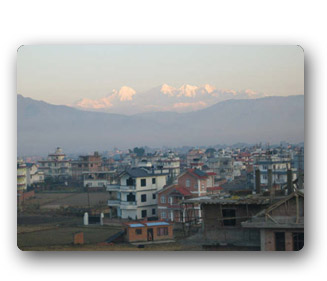
© photo APC
View of the Himalayan from the rooftop of Poonhill, in Dholahiti (Kathmandu).
|

KATHMANDU’S STREET CHILDREN
Who are they?
By definition, street children are children who made of the street their universe. However, one has to distinguish between « the children on the street » and « the children of the street ».
The children on the street are rather children who wander the streets in the daytime. They generally go back in their families in the evening and sleep there. These children do not go to school, in reason of a lack of money or interest of their families. Although scholarship is free in Nepalese public schools, there remain different costs when sending a child to school : the uniform, the books, school stationery, year-end exams … Some families have already difficulties to pay their food and rent ; they cannot afford extra expenses, nor can they spend time to take care of their children. That’s why some kids, who may be no older than 5, have no occupation in the day and spend most of their time wandering the streets with their friends.
This situation often precedes the situation of the « children of the street» who have already cut the links with their families.
These street children, called « Kathey » by Nepalese people, completely live in the street. The street has become their world, the friends their family. They keep very few, if any, contacts with their families, which in general live in the surrounding villages. Despite their youth, these kids can only rely on themselves for their survival. So they have recourse to different means allowing them to earn minimum money, buy food and entertain.
Origin of the street children.
Street children are children who cut the links with their family. They were already often left on their own devices in the daytime, wandering the streets with their friends. Their parents paid no more attention to their education, either by choice or by incapacity.
There are different interacting reasons that lead a child to leave home and definitively live in the street: parental alcoholism, illness, extreme poverty, high number of children, death of a parent and remarriage of the remaining one.
Little by little, the child is trying to flee away from family problems and is spending more and more time outside, in the streets, where life seems more attractive. In the street they have no constraint, no obligation ; they can play all day long with their friends. Then they find in this group what they can no more find in their families : the feeling of belonging to a group, mutual affection, solidarity…
The boundary between spending daytime in the street and living there completely is becoming more and more fragile and thin. The day comes when the kid prefers joining the friends and leaving
his careless family behind. The street is becoming
his new home and
his friends
his new family.
Street children’s daily life.
In a first time the street is synonym of freedom and playground for the kid. But once one lives in it, one has to be resourceful to survive, nourish, and find a place to sleep.
To do so, the kid has of several solutions : begging, stealing, prostitution, ragpicking ; the latter is what most children of Katmandu are used to do. One kilo of plastics can be sold between 10 and 15 rupees. Thus, several times per day, they can be seen wandering the streets and searching in the rubbish in order to collect plastics. They generally work in group and put together what they collected.
A large majority of street children live in bands in a place they have taken possession of. Very often they arrange it to enjoy minimum comfort. For instance, the kids living in Bhogal Park (in Kathmandu’s center) have disposed tarpaulins between two trees so that they are protected from rain, as well as from the look of the passers-by. Although they are sleeping in a park, they are not completely unorganized and ignorant of comfort and cleanness rules. From time to time, it happens that they brush up « their » park and collect papers and other rubbish. Similarly, they choose a very specific place, far from their bed, to act as toilets. Some other kids, who often do not belong to a specific group, may sleep under the temples.
After a few hours of picking up and reselling plastics, they generally earn enough money (100 to 150 rupees) to afford a decent meal (Dal Bhat costs around 20 rupees). Unfortunately most of them spend this money in priority in cigarettes, hashish, alcohol…which they largely consume, as well as glue that they repackage in small bags to “sniff” it later. Glue is a cheap and easily available product. Children consume it all day long. It makes them forget their reality and their living conditions.
Most of these children have acquired a strong community spirit as well as solidarity-based relationships. However they may be in the same time very harsh with each other. They fight a lot. In most cases it is just to play ; but they may also have real motives. Sometimes it ends up in the hospital in reason of the high violence.
However violence has a special position in Nepal. It is not unadvised and ill-perceived like in Western countries. Parents, teachers, or policemen – they all have recourse to violence. Therefore it may happen that, when children are struggling, passers-by stop, look and smile without interfering. They are fighting just as they could be playing marble or playing cards.
Very often, like in every group, there is a leader. Usually this role is imparted by the oldest and the strongest one. He then takes the decisions. He may also ask for money to the other kids, or even rob them. These latter have no choice but to submit, otherwise they could get excluded or beaten. Very often they accept these conditions, considering this is their duty.
There is a real culture relative to the life on the street. One of the main values is to keep free and have no obligation towards society. They give an account to no one except the leader of the group. They take liberty of everything and everything is allowed.
Since the street is their universe, they know it very well, know about all what is going on and know all the tricks. They are generally very resourceful and autonomous from the moment they immerge in this environment. It is for them the only way to survive.
That’s why they know how to use and benefit from the NGO and what they can offer: here a shelter, there some food, elsewhere activities and leisure…. It is not seldom that they navigate from one association to another without ever integrate one for good.
It is very difficult to take a child out of the street. On the one hand, it demands a deep and difficult readaptation (this difficulty increases with the number of years spent on the street) ; on the other hand, it involves for the kid the loss of the total freedom which he could enjoy and which became
his only treasure.
Traps of the street.
When living on the street, the children are exposed to many external dangers. Since their lives and situation are so fragile, they may fall from one moment to another in one of the numerous traps.
First of all, in order to forget their living conditions and because they are influenced, they use addictive products such as cigarettes, glue, alcohol or marijuana. No later than their early youth, they can be totally dependant to these products, what makes reinsertion very difficult, even impossible in some cases.
Furthermore some children prostitute, either to earn more money or because they are forced to. It often occurs with the tourists, but it is difficult to know where and how it takes place.
Once trapped in this machinery, the child cannot hope another life. It very quickly becomes dependant and prisoner of its way of life. Without any help, support or guidance, it is seldom that a kid manages by its own getting out of this world, going back to school, finding a job and an accommodation.
Street children missing of love.
A child leaving family home, is a child who does not feel well there and feels rejected. Even if
he does not completely live in the street,
he can often only rely on itself, without receiving any further education from
his parents or family. That’s how
he does no longer benefit from any protection and receives no more love, which is yet an essential object for the development of every kid.
This feeling of love promoted by the parents, allows the kid to feel secure and have self-confidence, for the very reason that
he feels
he is loved. Without that love and interest,
he shall grow up with the feeling of being undesired or useless.
He shall develop under-esteem and think
ihe can achieve nothing, for no one got interested in
him or trusted
him.
These children then suffer from a
enormous lack of love. They do not know what
it means to be loved and valorised.
The street children need this love, this interest, but in the same time they fear it, for it reminds them of painful experiences. They trust adults with difficulty, because they refer to the very suffer, embodied either in indifferent parents or adults in the streets who take advantage of their situation
Which solution?
This issue remains topical; otherwise there would be no more children on the street.
It is difficult to know precisely what could lead these children to get out of the street. There exists no panacea, simply because every kid is unique, with
his own history, and thus has specific needs. The child living in the streets is more than just a « street child ». He is a full and complex human being, with a background, a suffering, expectations and dreams which belong only
to him.
However, there remains a common feature between all those children. It is the necessity of finding a continuous, reliable relationship with an adult. A relantionship where
he can feel loved and valorised. Thanks to this link,
he can little by little, often after very much time, acquire self-esteem again and start believing in another life. It is for the adult, or the street educator, a very delicate task, which demands a consequent investment, since the transition period remains so difficult and painful for the child.
|